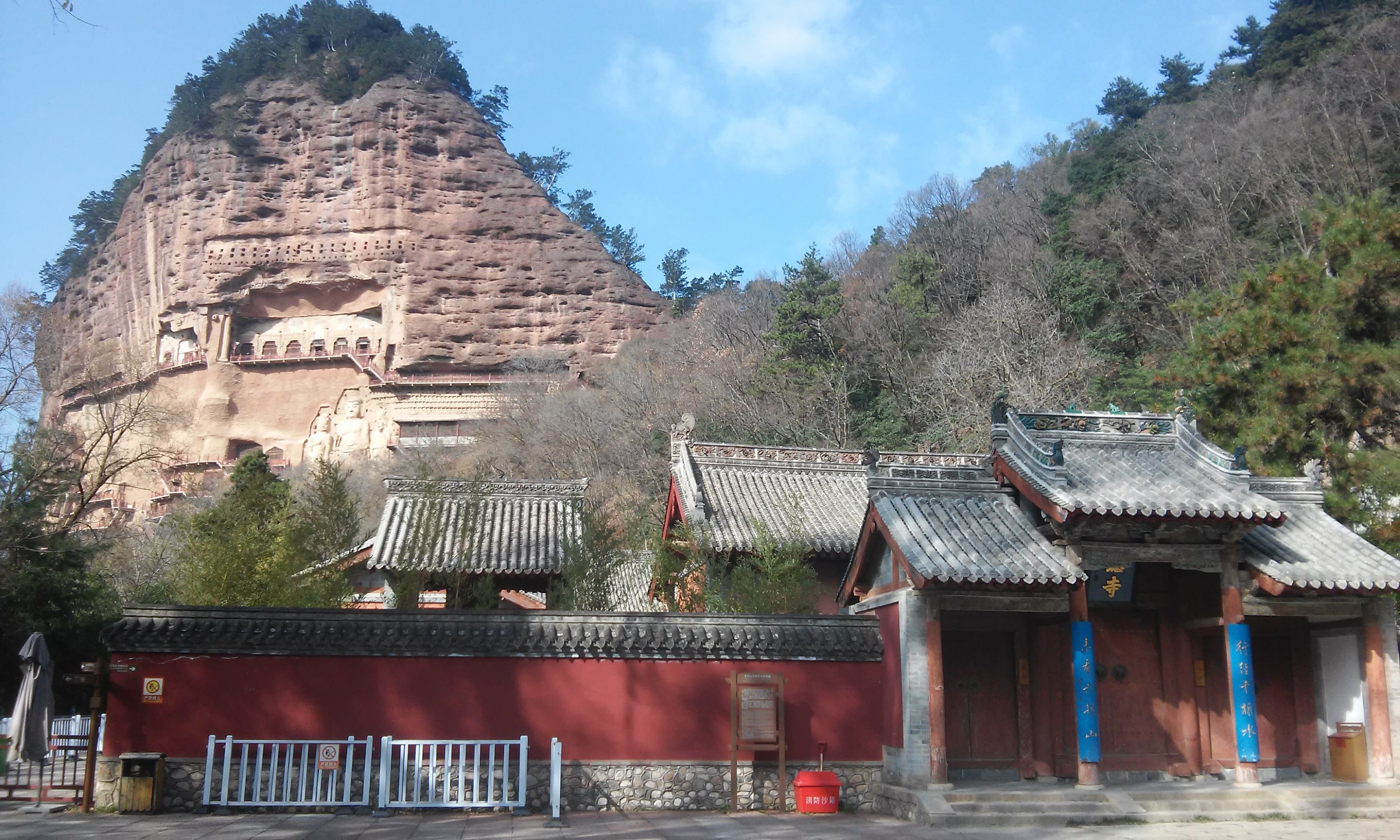
Maijishan — literally "haystack mountain" — is a sandstone butte forty-five kilometres southeast of Tianshui whose near-vertical faces have been colonised by Buddhist art since the late fourth century. Over 194 caves contain 7,200 clay sculptures and approximately 1,000 square metres of murals, the work of craftsmen working under the patronage of the Northern Wei, Western Wei, Northern Zhou, Sui, Tang, Song, and Ming dynasties across more than a thousand years of continuous use.
What distinguishes Maijishan from the other great Buddhist cave sites of China — Mogao at Dunhuang, Yungang at Datong, Longmen at Luoyang — is the medium. While those sites are carved primarily from rock, Maijishan's sculptures are made of clay built up over wooden armatures, a technique that demanded different skills and produced a different aesthetic. The Sui and Tang bodhisattvas have a warmth and expressiveness that feels more personal than the grander stone carvings elsewhere, while the Northern Wei sculptures are considered among the finest surviving examples of early Chinese Buddhist art.
Access is via a network of narrow wooden walkways and iron stairways bolted into the cliff face, which zigzag between the cave entrances at vertiginous heights. Some of the upper caves require booking in advance through a separate ticket system and are visited with a guide. The botanical gardens at the mountain's base are pleasant and worth time before or after the grottoes.
Maijishan is most easily visited from Tianshui, which has high-speed rail connections to both Xi'an and Lanzhou. Tourist buses run from Tianshui South Station to the site in about forty-five minutes.