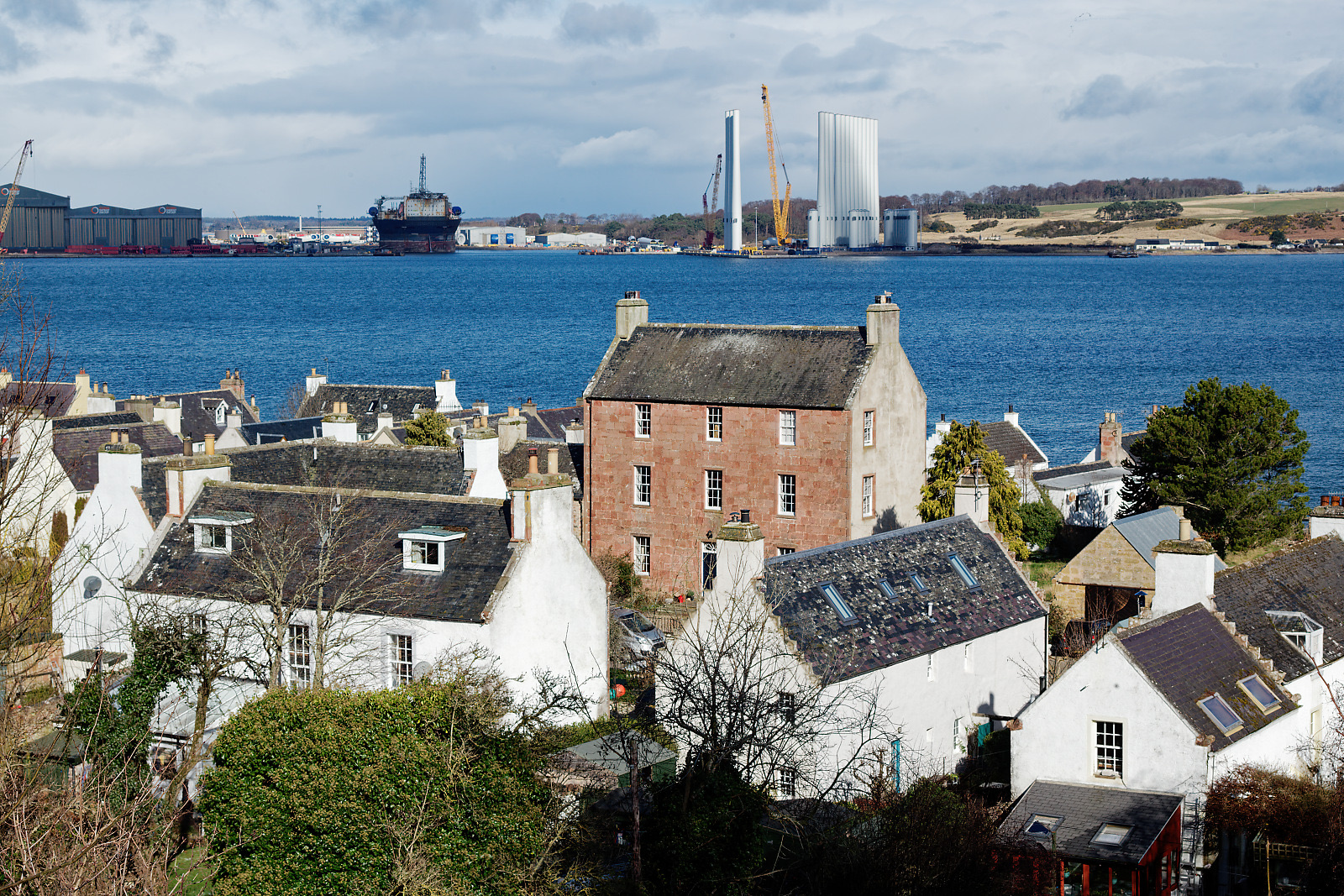
Cromarty sits at the very tip of the Black Isle, where the Cromarty Firth opens to the sea between two high headlands, the Sutors. It's tiny, with fewer than 700 people, but it's one of the best-preserved 18th- and 19th-century towns in Scotland. Georgian merchants' houses stand among lanes of whitewashed fishermen's cottages, and the whole place looks much as it did when it was a busy port shipping hemp, salmon and herring.
Most of that look dates from the 1770s, when the laird George Ross set out to build a little industrial town. He built a brewery, a hemp factory, a harbour designed by John Smeaton, and the Courthouse that is now the town museum. A few doors away is the thatched cottage where the stonemason, geologist and writer Hugh Miller was born in 1802. It's the only thatched house left in town. Behind it, the East Kirk is one of the best-preserved old Presbyterian churches in Scotland.
Look across the water and the 21st century is right there: the fabrication yards at Nigg, and often an oil rig or two parked in the firth. Somehow the contrast suits the place. Bottlenose dolphins come close inshore here, and boat trips run from the harbour, but the best place to watch them from land is Chanonry Point, about 10 miles back along the coast near Fortrose. Cromarty also has a lively arts scene for its size, with a small cinema, a December film festival and concerts in the restored brewery.
Cromarty is under an hour's drive from Inverness across the Black Isle. From June to September a small car ferry, the Renfrew Rose, crosses to Nigg. That makes Cromarty a handy shortcut north towards Tain and Dornoch.