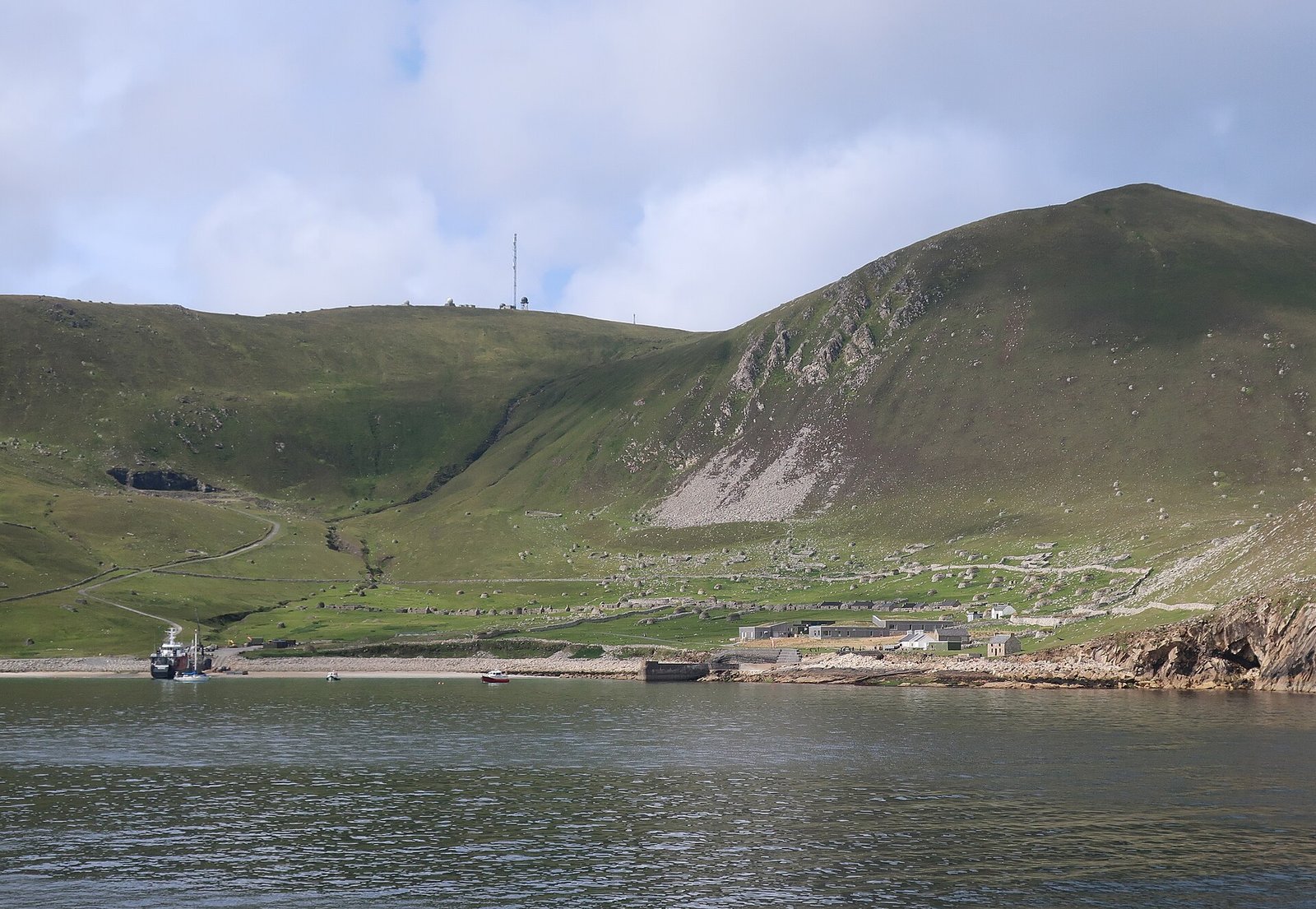
St Kilda is the edge of the British world: a cluster of volcanic islands and sea stacks 65 km west-northwest of North Uist, the westernmost of the Outer Hebrides. People lived on the main island, Hirta, for at least two thousand years, climbing the cliffs for seabirds and eggs and storing their harvest in hundreds of drystone huts called cleitean. In August 1930 the last 36 islanders, worn down by isolation, illness and crop failure, asked to be evacuated. Nobody has lived here permanently since.
The islands are owned by the National Trust for Scotland and are one of very few places in the world with World Heritage status for both their nature and their culture. Hirta's sea cliffs are the highest in the UK, and Stac an Armin and Stac Lee, off Boreray, are the highest sea stacks in Britain. Seabirds own the place: around 30,000 pairs of gannets, more than a hundred thousand pairs of puffins, and huge numbers of fulmars and Leach's petrels. The semi-wild brown Soay sheep, a Neolithic breed, graze among the ruins, and the St Kilda wren and St Kilda field mouse live nowhere else.
Most visitors land for a few hours on a day trip. Boats sail in summer from Leverburgh on Harris and from Stein on Skye: a three- to four-hour crossing each way over open Atlantic, around four hours ashore on Hirta, then a circuit of the stacks and Boreray on the way home. You transfer to a small inflatable to land, and nothing — no rats, no dogs — is allowed to come ashore with you. Operators run trips over a two-day window and sail on the first suitable day, so build slack into your plans. Even then, swell from the east can make landing impossible.
Ashore, life centres on Main Street in Village Bay, the row of 1860s cottages with a small museum, the restored church and school, and the cleitean scattered up the slopes. There is a ranger and a working military radar base, but no café and almost no facilities. Bring food, waterproofs and a strong stomach for the crossing — and a camera for the climb towards Conachair if time allows.