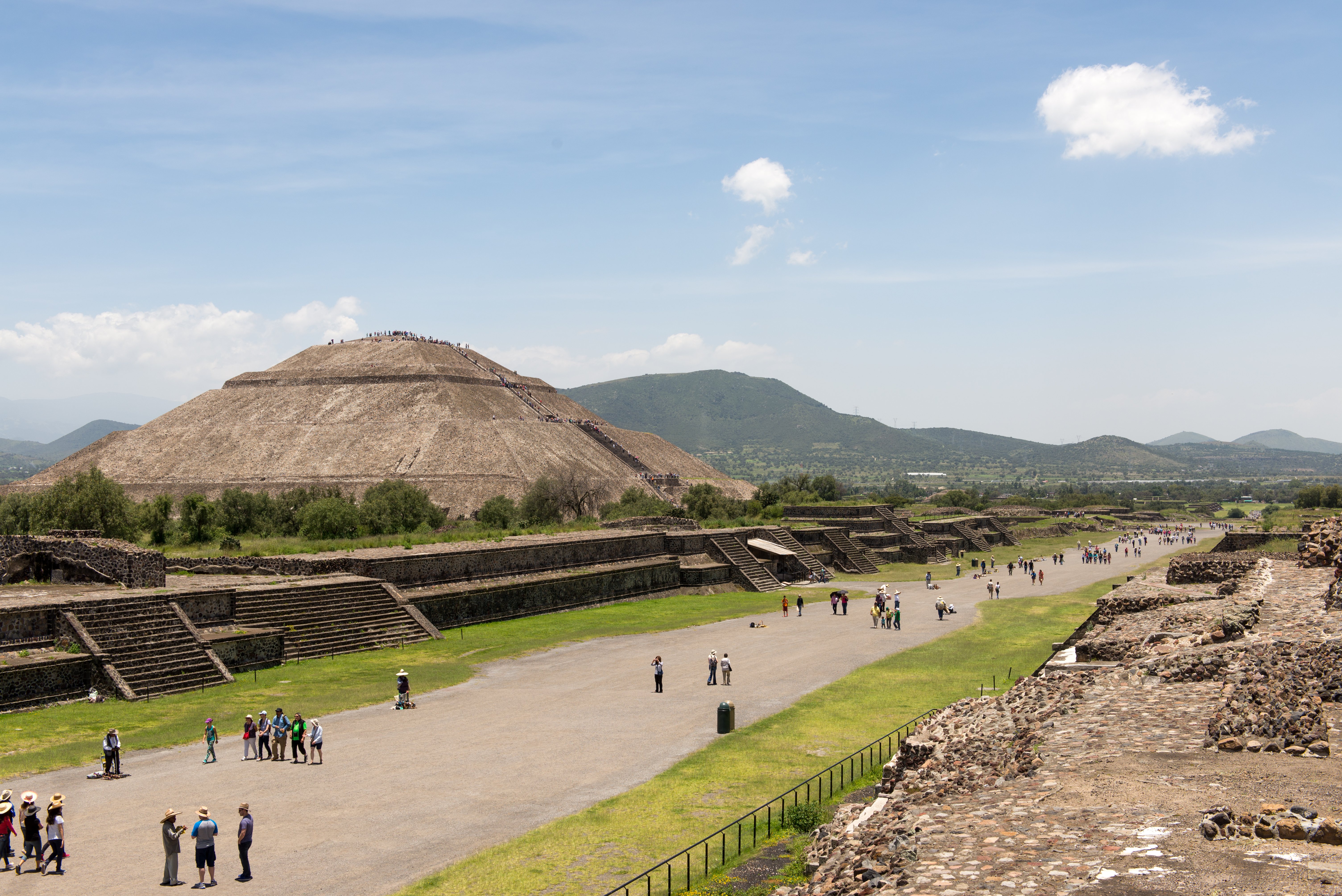
Teotihuacan is one of the most impressive ancient cities in the Americas, located about 50 km northeast of Mexico City — roughly an hour by road. At its peak between the first and seventh century AD, it was the largest city on the continent, home to perhaps 125,000 people, and its influence extended across Mesoamerica.
The site is dominated by two enormous pyramids. The Pirámide del Sol is one of the largest structures in the ancient world — about 220 metres at its base and 65 metres high. The Pirámide de la Luna anchors the northern end of the Avenue of the Dead, the great processional boulevard that runs through the city's heart. At the southern end stands the great walled Ciudadela enclosing the carved Temple of the Feathered Serpent.
The ruins are vast and easily fill a full day, especially if you visit the murals at the Palace of Quetzalpapálotl or explore the residential compounds of Tepantitla, Atetelco, and Tetitla, where some of the best surviving murals are housed. The site museum and the Beatriz de la Fuente Murals Museum are both worth thirty minutes each.
Go early to beat the heat and the crowds. The site is open daily and buses run regularly from the Terminal del Norte in Mexico City. For lunch, La Gruta — the cave restaurant just outside Gate 5 — has been in business since 1906.