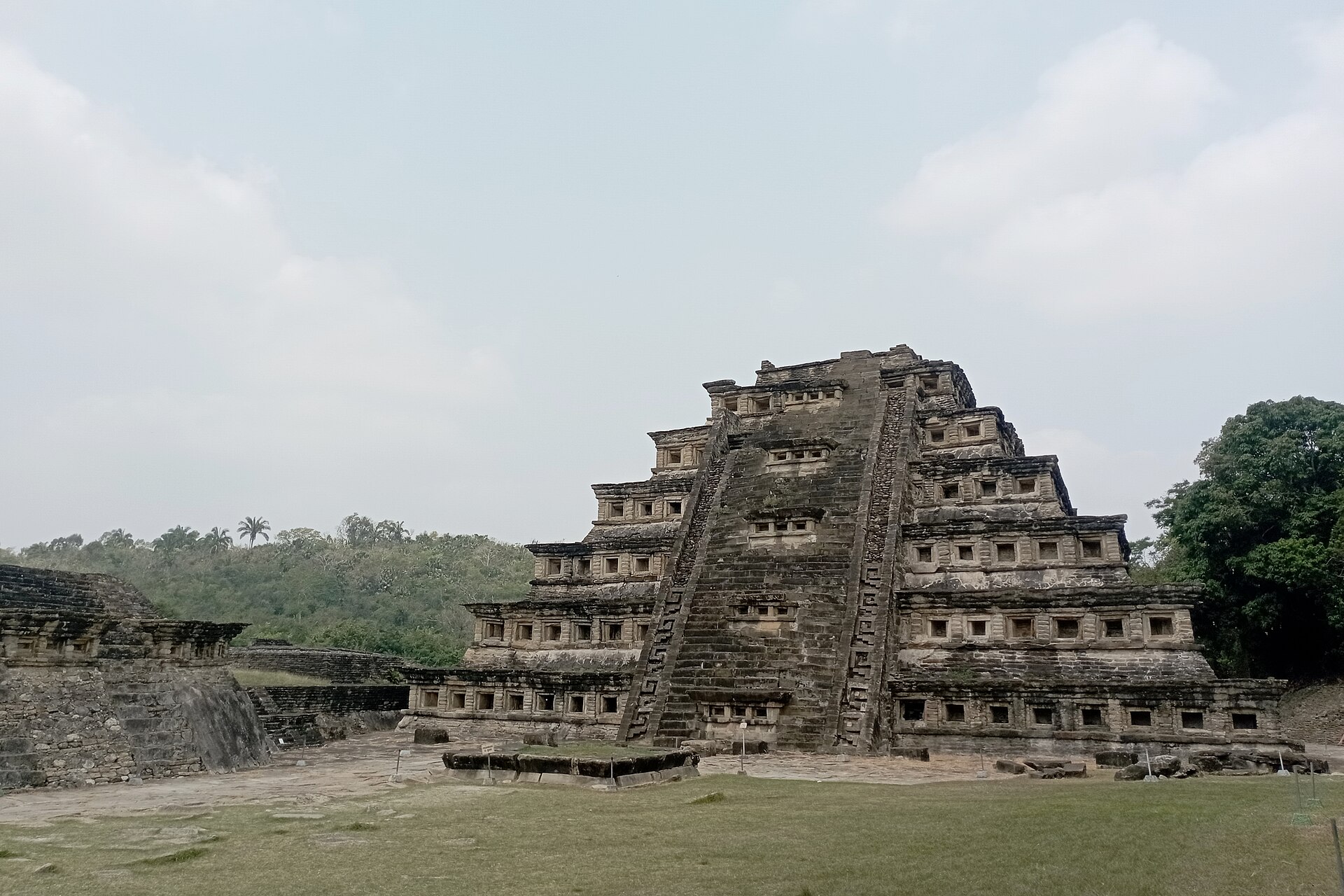
El Tajín was the principal city of the Gulf coast between roughly 800 and 1200 AD, built by people usually identified with the Totonac, and it looks like nothing else in Mexico. UNESCO listed it in 1992.
The Pirámide de los Nichos is why: a stepped pyramid whose faces are covered in square recesses, 365 of them, each originally painted — one for every day of the solar year. It is the most arresting single building on any Mexican site and it was buried under forest until a Spanish official stumbled on it in 1785.
The city has at least seventeen ball courts, more than any other Mesoamerican site, and the carved panels on the South Ball Court show the ball game ending in the sacrifice of a player, with the gods looking on. Whether the winner or the loser was killed is still argued; the panels do not settle it.
Only a fraction of the site has been cleared. The Tajín Chico complex on the terrace above holds the Building of the Columns, whose carved drums record a ruler named 13 Rabbit.
The site stands in low jungle an hour inland from the coast, near Papantla — the town that gave the world vanilla, which is native to this forest and was first cultivated by the Totonac. Outside the entrance, the voladores perform: five men climb a thirty-metre pole, four tie themselves by the ankle and descend head-down in thirteen revolutions each while the fifth plays flute and drum on the platform above. Thirteen times four is fifty-two, the years of the Mesoamerican calendar round. UNESCO lists the ceremony separately as intangible heritage.
There is no shade and it is hot and humid most of the year. Come early.