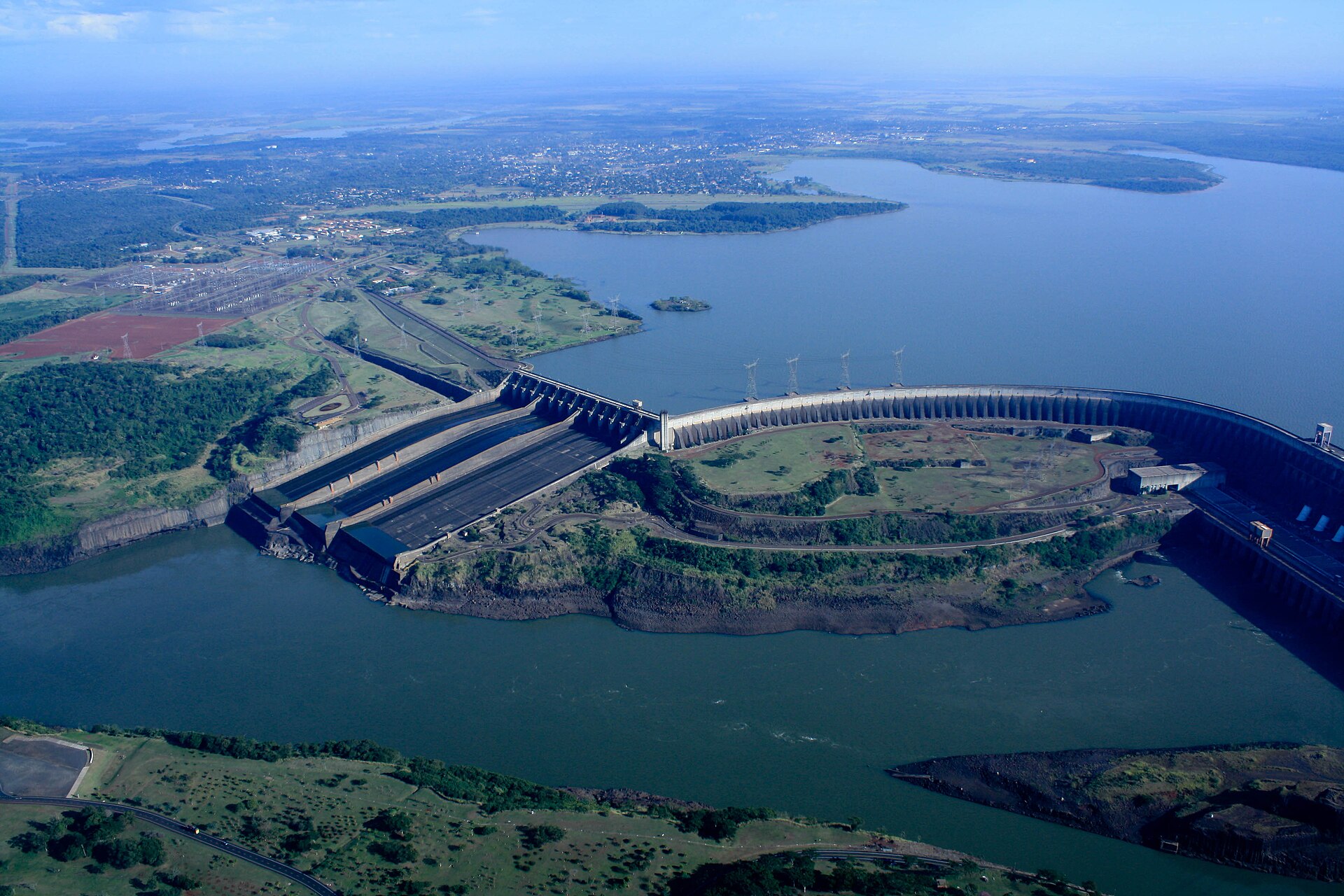
Itaipú is a wall of concrete 7.9 km long and 196 m high across the Paraná, jointly owned by Paraguay and Brazil, and for a quarter of a century it was the largest power station on earth by output. Three Gorges overtook it on installed capacity; Itaipú still holds the annual generation record from 2016, 103.1 TWh, because the Paraná runs more steadily than the Yangtze.
Scale is the whole point of the visit. Twenty turbines, ten running on Paraguayan 50 Hz and ten on Brazilian 60 Hz, which is why the machine hall has a line down the middle where the frequency changes. The standard panoramic tour is free, runs several times a day from the visitor centre in Hernandarias, and takes you along the crest by bus. The technical circuit costs more, needs booking, has a minimum age and a closed-shoes rule, and goes down inside the machine hall — take it if you have any interest in engineering at all, because the turbine floor is one of the great industrial spaces.
Twice a week after dark the dam face is floodlit for an hour. It is a genuinely strange spectacle and locals treat it as an evening out.
The dam drowned the Guaíra Falls in 1982 — by volume the largest waterfall in the world, gone under 170 km of reservoir. The town of Salto del Guairá is named after a waterfall that no longer exists. Itaipú's own answer to this is a chain of biological refuges on the reservoir shore; Tati Yupi, the closest, has walking trails, free entry and a good chance of capybara and howler monkeys, and the Bioparque next to the visitor centre keeps animals rescued when the forest flooded.
Go from Ciudad del Este: buses to Hernandarias run constantly and take about 40 minutes, or a taxi is cheap and quicker. Bring your passport — it is a binational installation and they check.