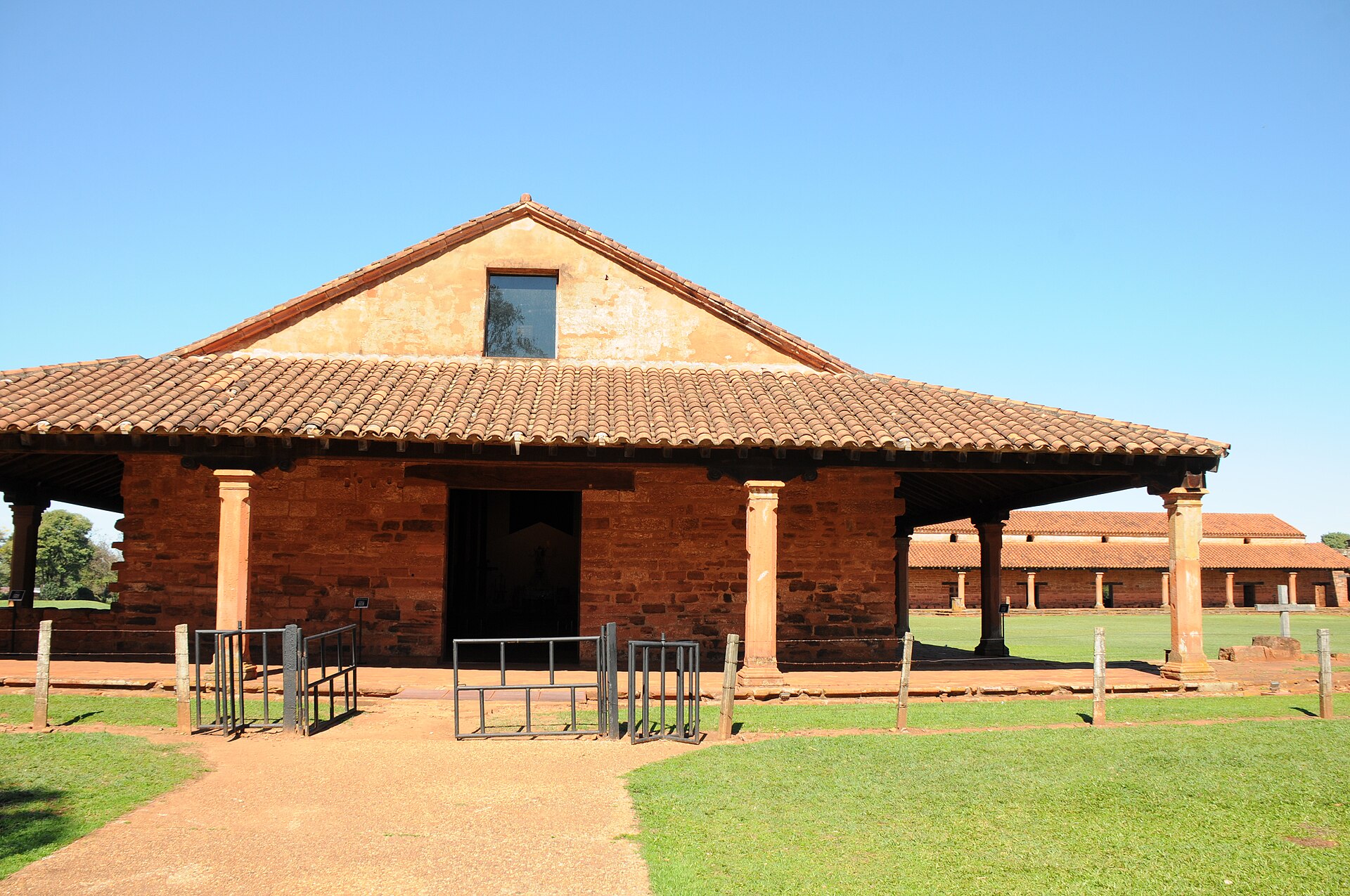
San Cosme y Damián is the mission that did astronomy. Founded in 1632 and moved to this spot on the Paraná, it housed Buenaventura Suárez, a Jesuit born in Santa Fe who arrived in 1703, ground his own lenses, built his own telescopes out of local materials, and spent thirty years observing the moons of Jupiter and timing eclipses accurately enough that European observatories corresponded with him. His Lunario de un Siglo, a hundred-year almanac of lunar phases and eclipses calculated for the meridian of the missions, went through several editions.
The mission survived better than most. The church is restored and still in use; the college and the long row of workshops stand; there are twenty-odd wooden saints inside. Compared with Trinidad it is plain and low, and its appeal is that it is inhabited rather than excavated. The stone sundial in the courtyard is Suárez's.
Next to it the town runs a small astronomical centre — a planetarium dome and a telescope, built in 2010 — which is a nice piece of continuity and worth an hour if it is open. Check ahead; the hours are erratic.
The site is covered by the same Gs 25,000 three-day ticket as Trinidad and Jesús, but it is awkward to reach: it sits 25 km off Ruta 1 down a spur road, about 65 km west of Encarnación, and public transport is thin. Most people either drive or take a tour. The town also has a stretch of Paraná beach that was a real draw until the river shifted and took most of the sand.