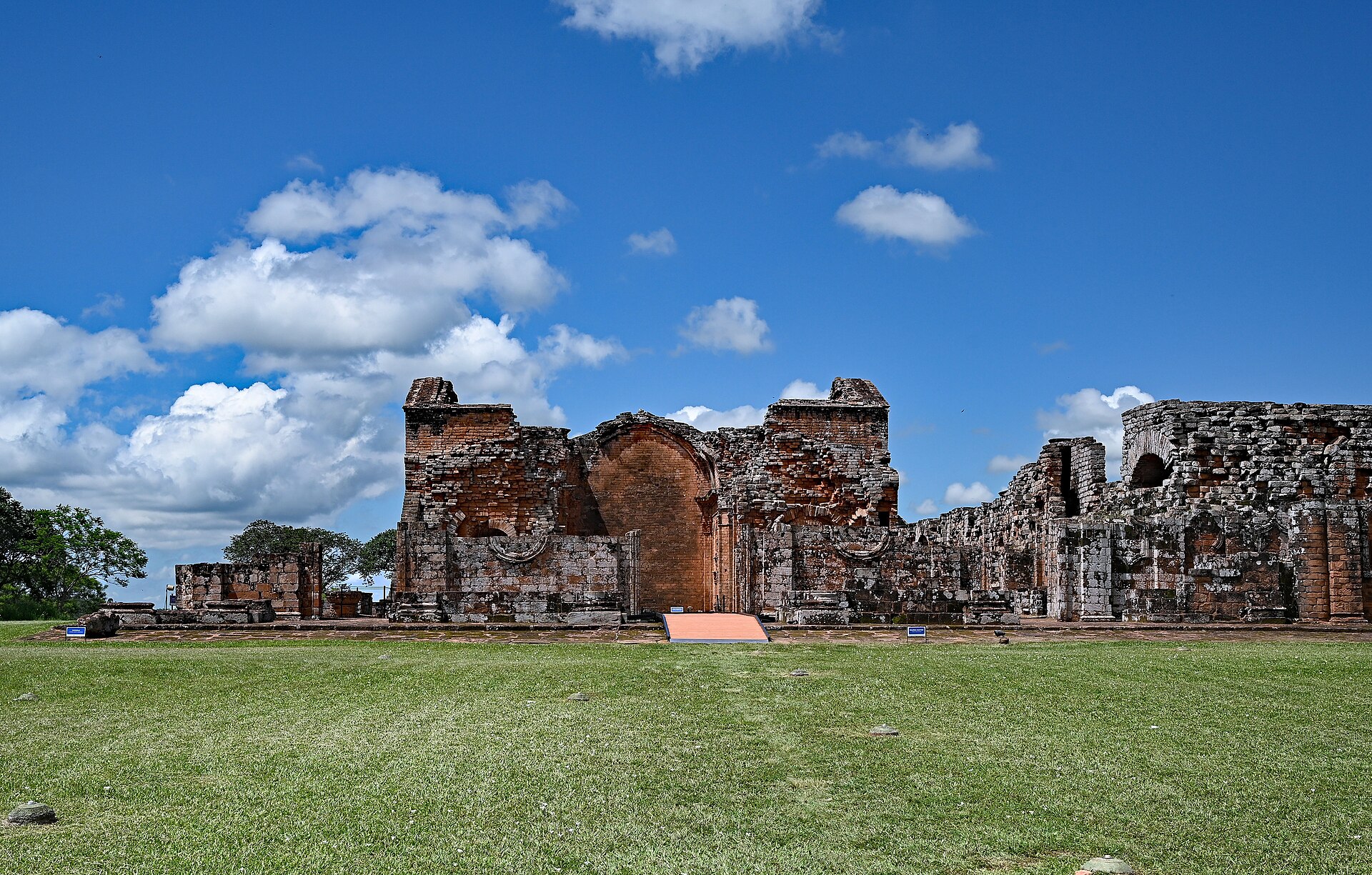
Trinidad is the biggest and best-preserved of the thirty Jesuit-Guaraní missions, and the only place in Paraguay on the UNESCO list. It sits on a low rise off Ruta 6, 28 km north-east of Encarnación, and it is built almost entirely of the local red sandstone, which turns a deep rust colour in late light.
What survives is a whole town plan, not just a church. You walk in past the rows of one-room indigenous houses, across a plaza the size of a football pitch, to the main church — the largest the Jesuits built anywhere in the Paraná missions. Inside, the carved stone frieze of angels playing baroque instruments is still on the wall: clavichord, harp, trumpet, maracas. Guaraní craftsmen cut it. Behind the church stands the older, smaller church and the free-standing bell tower, and off to one side the workshops where the mission made its own iron and tiles.
At its height Trinidad was a self-governing community of several thousand Guaraní producing yerba mate, cattle and some of the best musical instruments in the Spanish Empire. The Jesuits were expelled in 1767; within a lifetime the place was roofless. Nobody rebuilt it, which is exactly why it is worth seeing.
Entry is a single ticket, Gs 25,000, valid three days and covering Jesús de Tavarangüé and San Cosme y Damián as well — buy it here, it is the same ticket at all three gates. Open roughly 07:00–19:00 in summer, closing 17:30 in winter. There is shade at the entrance and almost none inside, so go early or go late; midday in January is punishing. Buses from Encarnación heading for Ciudad del Este drop you at the crossroads on Ruta 6 in about 45 minutes for around Gs 15,000, and the site is a ten-minute walk from there.
Give it two hours. Then go on to Jesús, half an hour further, and do both in a day.