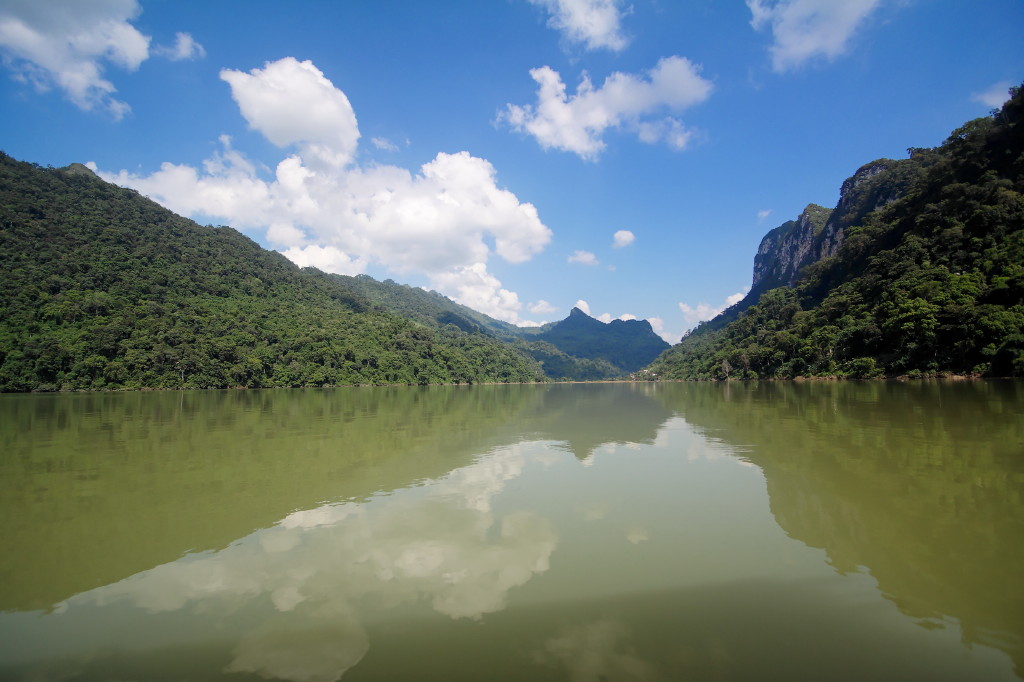
Northern Vietnamese national park centred on a mountain lake below limestone karst and evergreen forest.
Ba Be National Park sits in Bac Kan province, about 250 km north of Hanoi, and is built around one of the most striking landscapes in northern Vietnam. At its heart is Ba Be Lake — the name means "three lakes", though the lake is a single continuous body of water 8 km long and up to 800 m wide. At 178 m above sea level, it is Vietnam's only significant natural mountain lake, set among limestone karst peaks that rise above 1,000 m and drop sharply to the water's edge.
The park covers 7,610 hectares of limestone karst and lowland evergreen forest, with over 550 plant species recorded and a freshwater ecosystem that supports endemic fish found nowhere else. Among the mammals: Francois's Langur, Owston's Civet, slow lorises, and bears. The place is comparably beautiful to Ha Long Bay or Ninh Binh — and far less visited.
The standard itinerary is a day on the water, with a wooden motorboat tracing the Nang River from the lake into Puong Cave — a river cave where tens of thousands of bats roost overhead — and on to Dau Dang Waterfall at the southern end. Trekking trails lead into the forest and to the villages of the Tay, Dao, and H'Mong minority peoples who live in and around the park.
Most visitors stay in homestays in Pac Ngoi village, a Tay minority settlement on the lakeshore where wooden stilt houses open directly onto the water. It is the right choice over Cho Ra town. Ba Be is a full-day journey from Hanoi by bus, or five to six hours by private vehicle.
Guide
Getting There
Ba Be is 250 km north of Hanoi. The journey takes five to six hours by road and requires either a private vehicle or a combination of public transport.
By bus and minibus: From Hanoi's My Dinh bus station, take a bus to Bac Kan city (around four hours). From Bac Kan, local minibuses or a hired motorbike taxi run the remaining 70 km to the park entrance and Cho Ra. The Bac Kan–Ba Be leg takes around two hours on a winding mountain road.
By organised tour: Most travellers reach Ba Be on a two- or three-day guided tour from Hanoi. These are sold by tour operators on the Old Quarter's Ma May and Hang Bac streets. The convenience is real — transport, accommodation, and boat trips bundled together — and the tour groups are small enough that it does not feel industrial.
By private vehicle: Renting a car or motorbike from Hanoi is the most flexible option. The route north via Highway 3 through Thai Nguyen and Bac Kan is well-surfaced for most of its length. Motorcyclists should allow six to seven hours. The final stretch from Cho Ra into the park follows the lake and is one of the better stretches of road in northern Vietnam.
There is no rail connection to the park area. The nearest train station is in Bac Kan, which is not on a main line and serves only slow local trains.
Guide
When to Go
The best months to visit Ba Be are October to April, when the weather is dry and clear. The lake is at its most reflective in October and November, when the air is sharp and the limestone peaks catch the morning light. December and January can be genuinely cold — the park sits at nearly 200 m above sea level and the valley channels the wind — so bring a layer.
The wet season runs from May to September. Rain is heavy and persistent, and trails into the forest become slippery. The upside: the Dau Dang Waterfall is at full power, and the forest is at its greenest. The lake does not flood badly, and boat trips continue through the rainy season. July and August see the highest rainfall.
Ba Be has no major festival that would make it worth timing a visit around. The Tay New Year (late January to February, aligned with the lunar calendar) is celebrated quietly in the villages with communal meals and traditional games — if you happen to be there, you may be invited to join.