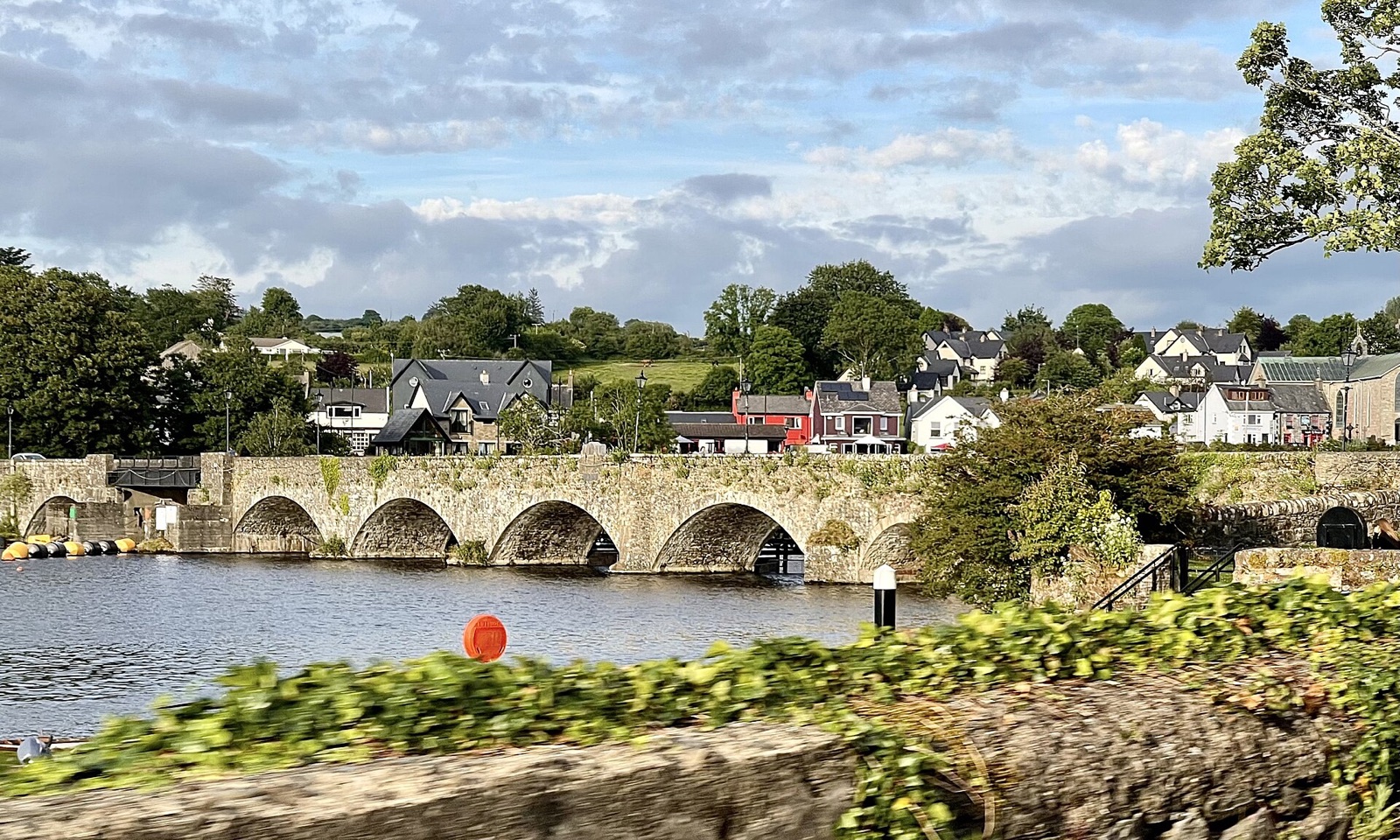
Killaloe is a small town on the west bank of the River Shannon, where it leaves Lough Derg in County Clare. Across the water is its twin, Ballina, in County Tipperary, and the two are joined by Killaloe Bridge, a 13-arch stone bridge that has been for pedestrians and cyclists only since a new road bridge opened downstream in 2025. Killaloe is the older and prettier of the pair, its streets climbing the hill from the river. Ballina is bigger, with most of the places to eat, drink and stay.
This crossing was once the centre of Ireland. Brian Boru, the Dál Cais king who became High King and broke Viking power at Clontarf in 1014, was based here, and his palace of Kincora stood on the hill where the Catholic church is now. Between 1002 and 1014 Killaloe was in effect the capital of the whole island. His earlier fort, Béal Ború, is a ring fort 2 kilometres north of town at the head of the lake.
The town's church history goes back further still, to a monastery founded by St Molua in the 6th century. St Flannan's Cathedral, built between 1185 and 1225, keeps a Romanesque arch from the first building and the Thorgrim Stone, carved in both Norse runes and Irish ogham. In the grounds of the Catholic church stands St Molua's oratory, a small stone church that was moved here stone by stone from Friar's Island when the Ardnacrusha hydroelectric scheme raised the river in the 1920s (see St Flannan's Church).
Killaloe is a base for the water and the hills. River cruises leave from the quays into Lough Derg between April and September, there's a marina, and the Lough Derg Way walking route passes through on its way from Limerick to Dromineer. West of town, Moylussa is the highest point in Clare. Bus 345 runs from Limerick in about 40 minutes.