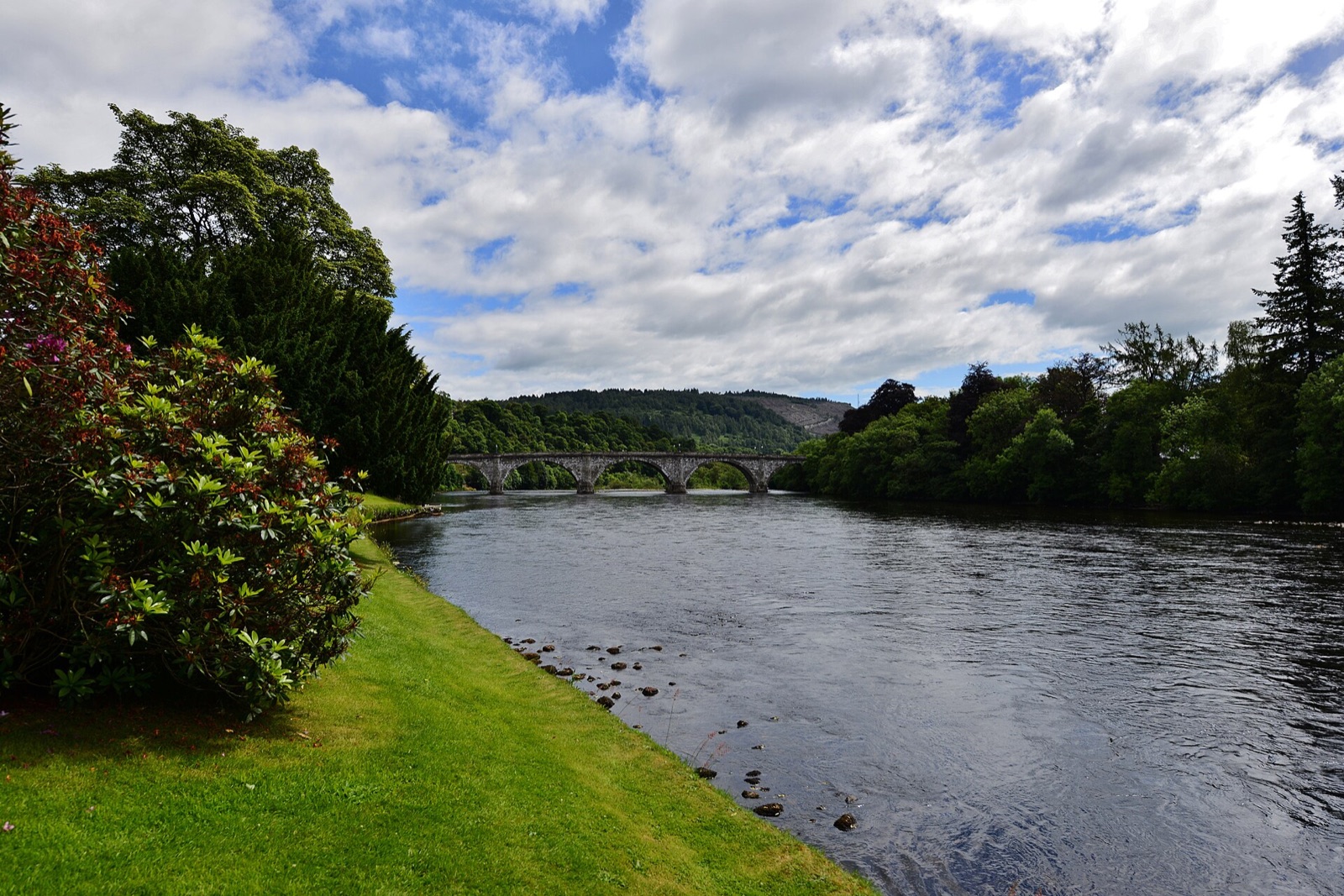
Dunkeld is where the Highlands start. The town sits on the north bank of the Tay just past the Highland Boundary Fault, with its twin village of Birnam across Thomas Telford's seven-arched bridge of 1809. The name, Dùn Chailleann, means "fort of the Caledonians". In 849 Kenneth MacAlpin is said to have brought St Columba's relics here from Iona to keep them safe from the Vikings, and for a while this was the leading church site in eastern Scotland.
The medieval town was nearly wiped out on 21 August 1689, when Cameronian government troops held off the Jacobites in street fighting a few weeks after Killiecrankie. You can still see musket-ball holes in the east gable of the cathedral. The town that went up afterwards has survived almost untouched. Cathedral Street and the Cross are lined with harled 18th-century houses, about twenty of them restored by the National Trust for Scotland, and there's a fussy neo-Gothic fountain of 1866 in the old market place. It's one of the most complete small Georgian burghs in Scotland, and it takes an hour to see and much longer to leave.
The area is sold as Big Tree Country, and for once the slogan is fair. Across the river stands the Birnam Oak, said to be the last of Macbeth's Birnam Wood. West of the A9, the Hermitage puts tall Douglas firs and a Georgian folly above a roaring waterfall. Two miles northeast, ospreys nest at Loch of the Lowes. Birnam also has a small Beatrix Potter garden, a reminder of the holidays she spent in the area as a child.
Dunkeld & Birnam station on the Highland Main Line has trains every hour or two from Perth, Edinburgh and Glasgow, and buses run hourly from Perth. Pitlochry is 14 miles north. Dunkeld makes a better base than either for a slow couple of days of woodland walks.