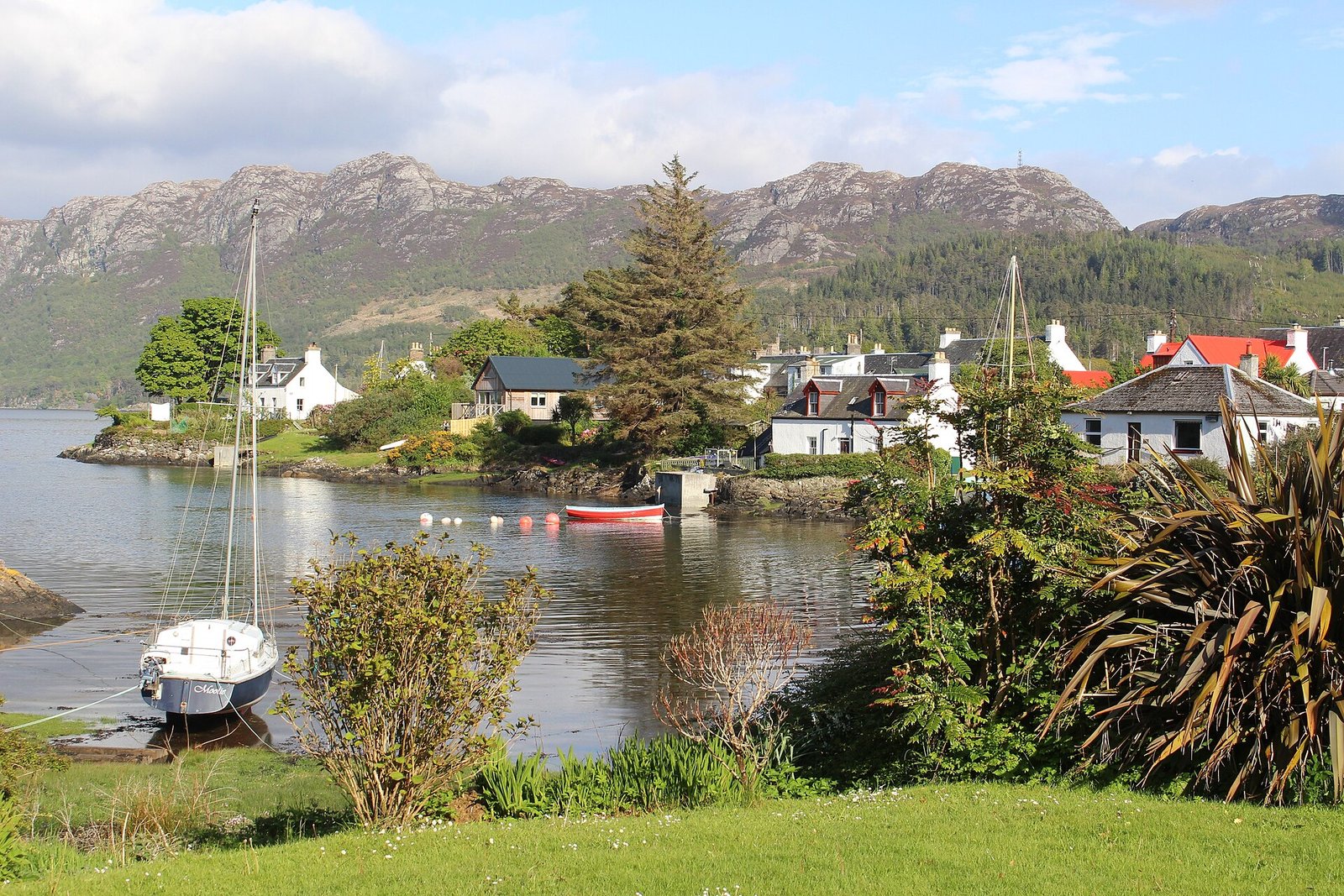
Plockton has been called the prettiest village in the Highlands, and it's hard to argue. A curve of whitewashed cottages faces east across a sheltered inlet of Loch Carron, yachts swing at their moorings, and along Harbour Street a line of New Zealand cabbage trees gives the place an oddly subtropical look. The trick is the aspect — the village turns its back to the prevailing wind — plus the mild breath of the North Atlantic Drift.
It was built as a planned fishing village around 1800, when the landowners cleared people from the inland glens to make way for sheep. Most of the houses date from the 19th century, and the village is now surrounded by the National Trust for Scotland's Balmacara Estate. Artists have painted here for more than a century, and television made it famous: Plockton stood in for Lochdubh in Hamish Macbeth, and scenes from The Wicker Man were filmed here too.
Plockton is also unusually Gaelic and unusually musical. The high school hosts Scotland's National Centre of Excellence in Traditional Music, and the poet Sorley MacLean was headmaster here from 1956 to 1972. The primary school catchment has the highest share of Gaelic speakers anywhere on the Scottish mainland.
There's little to "do" in the formal sense. Walk out to the Coral Beach, climb to the viewpoint at Carn na Frith-aird, take a seal-spotting boat trip from the harbour, and settle into one of the village's three hotel bars. Plockton is on the Kyle of Lochalsh railway from Inverness, with the halt a mile from the village, and Kyle of Lochalsh and the Skye Bridge are about seven miles away by road. In summer it fills with day visitors; stay the night and you get the evening to yourself.