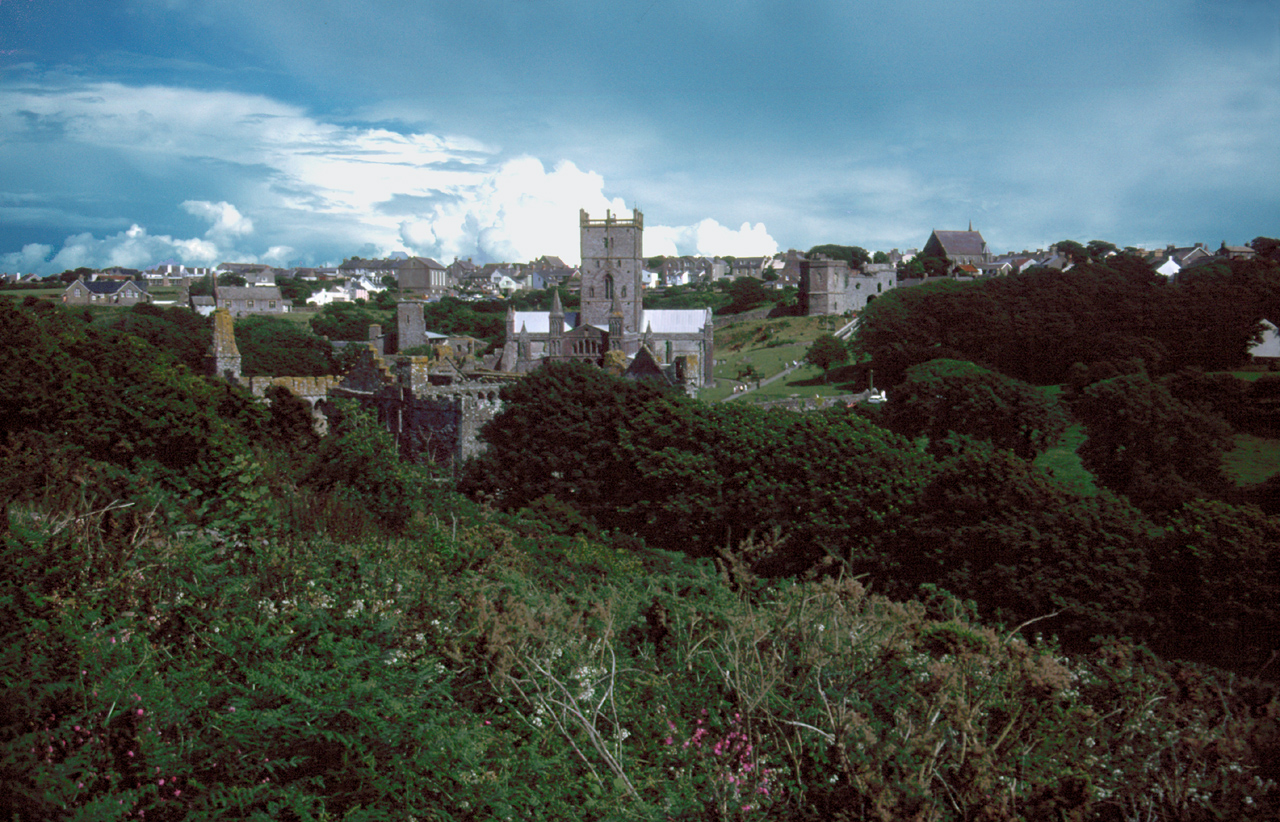
St Davids has fewer than two thousand people and still counts as a city, the smallest in Britain, because of its cathedral. The cathedral itself is the surprise: you walk through the little town square and down a flight of steps, and there it is, sunk out of sight in a green hollow beside the river Alun with the ruined Bishop's Palace next to it. The site has been a place of pilgrimage since the Middle Ages, when two journeys to St Davids were said to equal one to Rome.
The other reason to come is the coast. St Davids sits on the peninsula at the far western end of Wales, and the Pembrokeshire Coast Path loops around it past St Non's Bay, the old harbour at Porthclais and the beach at Whitesands Bay, one of the best surf beaches in the county. Offshore, Ramsey Island is an RSPB reserve, with grey seals breeding on its beaches in autumn, and the boats that circle it leave from the lifeboat station at St Justinian's. Further out are the seabird colonies on Skomer and Grassholm.
This is also where coasteering began: scrambling, swimming and jumping your way along the base of the cliffs, now offered all along the Welsh coast. Several of the outdoor companies that run it are based in the town. For a small place, St Davids has a good spread of cafés and galleries, and it is busy in July and August. Spring and early autumn are the best times to come.